

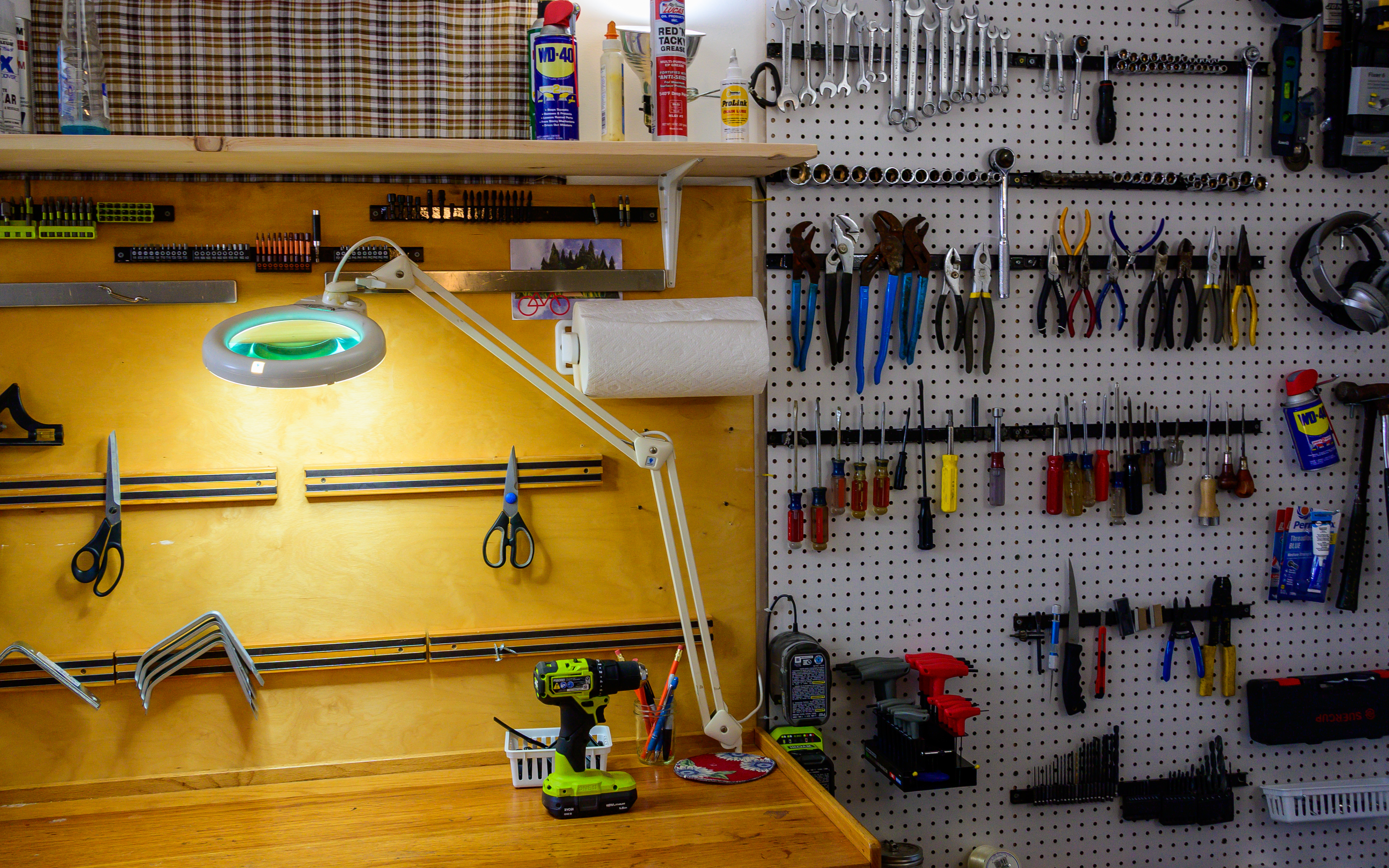
Winter has come and when you can’t get out and ride, you do maintenance and add accessories to your set up to make it better for Spring. General maintenance is done on a regular basis, but this is a good time for that deep cleaning, oiling and inspection of all the components to gauge their wear.
Scott got a bike stand for his birthday that is heavy duty enough to hold the weight of the e-bikes. This makes working on them so much easier. It is a really nice one and we are very pleased with it.


This year we decided that, even though we had worked so hard on Edgar’s trailer, we wanted to try making him a bucket that would snap into Scott’s rear bike rack. We have different rack latching systems on the Verve and the Allant. The Allant is Scott’s bike and it has an aftermarket rack on it that we installed after removing the integrated fender rack that came on the bike originally. That process was a nightmare, but is content for another time.
Scott’s rack, is also a Trek product and works very well as a basic rear rack. The rack attaches to the seat post and to the rear axle. It has a Topeak MTX 2.0 mounting system, so any accessory that you purchase compatible with that mounting system will slide onto the rails and latch in place.
We looked very hard for a bucket using that latching system that was large enough for Edgar to sit in comfortably and that was open on the top. He does not like being enclosed in a kennel, or bag, so all the pet carrier options really wouldn’t work for our purposes.
We settled on a hard sided collapsible bucket that already had the latch system and, sadly, the bucket was not the size advertised. The dimensions listed for the bucket on the website say the bucket was 17.4″D x 14.1″W x 13.4″H, and they were way off. Even measuring the outside dimensions, there was not one that came close to 17.4″. Edgar just would not fit in this bucket and be happy.
So, we did what we usually do, we improvised. The end result was far better than expected. Here is what we did.
We took one of Edgar’s old soft sided kennels (the one we used to pick him up from the breeder many years ago) and attached it to a solid piece of hardwood (not pine) that we had painted black. Since the bucket we bought already had the latch integrated into the base, we removed the base from the purchased bucket and bolted it to the wood kennel platform we made.
Scott also attached another strip of wood to the back end of the wood platform to act as a support for the bucket when it was taken off the rack and set on the ground. This keeps it from rocking when he sits in it on the ground.
There is a built in leash inside the carrier that is long enough for him to sit upright with the top open, but still be securely strapped in. This carrier will only work on Scott’s bike rack, as mine uses the MIK latching system, but for now we are happy with how this one turned out.


I also took this time to make some much needed bags for tools, etc. I used scrap cardboard to make templates for the sides of the bags and made note of where I wanted the zipper(s) and where the velcro attachment strips were to be located. Then, I decided how deep/wide I wanted the bag to be. I cut waterproof canvas using the templates I had made, making sure to cut the sides opposite so there was a right/left side and I cut a strip the width I wanted the bag to be by a length that would go all the way around the outer dimension of the template plus a few inches.
I sewed the zipper(s) into the side panels first and then assembled the bags by sewing the strip of fabric all the way around one side (with right sides together), inserting the velcro strips in the seam where they were supposed to be in the seam allowance as I went around. Then I attached the other side in the same manner. I turned the whole bag right side out through the zipper and it was complete.


